
I’ve been helping executive job seekers with resume writing, LinkedIn profile writing, other job search-related materials and strategy for more than 20 years.
You’d think resume writing would be that much easier after all that time, but it’s not.
Resume writing is complicated. These days, so much more is involved than merely detailing a client’s career history.
When I started my business resumes were mostly lifeless, dry career history documents, listing job responsibilities and perhaps an accomplishment or two. They were easier to write then.
When LinkedIn first made an appearance in 2003 and other social media quickly began having an impact on job search, resume writing began to get more complicated.
In fact, some say LinkedIn makes the resume obsolete. I don’t agree.
Both resumes and LinkedIn profiles are necessary and serve different purposes. And they need to be in sync with each other, so they work together the right way.
7 Things That Changed Everything For My Resume Writing
As I evolved as a resume writer and careers industry professional, and as job search evolved, I learned certain things along the way that cumulatively inform the way I approach resume writing:
1. A resume is a personal marketing document, not merely a career history.

As I noted above, for many years resumes consisted of a chronological list of jobs, with maybe a little about responsibilities thrown in.
Education, training, honors, and other distinguishing information followed the professional experience section. Sometimes a brief summary would lead the resume.
Today, and for a long time now, a resume needs to market the candidate by reinforcing what specifically makes her potentially valuable to the employer.
It needs to convey personality, so employers will get a feel for how she works with others, and if she’ll fit with the company’s culture.
The easier a resume makes it for an employer to connect the dots between the candidate’s qualifications, experience and ability to add value in specific ways, the better the resume will work.
This also means that the formatting of the resume needs to be attractive and reader-friendly (on mobile devices, larger computer screens and on paper), with important blocks of information highlighted to draw the eye to them.
2. Resume writing without first targeting and researching specific employers won’t fly.

Following the thinking in #1, anyone familiar with marketing knows that step one is identifying your target audience and specific pain points of theirs that you’re qualified to help them fix. Then you’ll have the info you need to build marketing communications around how you will help them.
In order to effectively market a candidate, their resume development needs to begin by narrowing focus to particular employers and roles.
Next step is researching each target employer to uncover plenty of information about them for the specifics needed to position them as a good hiring choice in their resume.
Without knowing how the candidate will bring value to a company or organization, it’s pretty hard to sell them as a necessary hire.
3. The things about you that make you a good fit for your target employers will drive your resume writing.

This is where a lot of job seekers and some resume writers falter.
They lean most on what the job seeker considers to be her top strengths, skills and achievements. But those particular things may not be what’s most important to her target employers.
You need to clearly show employers that you have what they need to get certain things done.
The only way to know, is to do the research to find out what it is about you that they need.
4. A resume needs to be an interesting read and give a feel for your personality.

If you’ve been in a position to review even a few resumes here and there, you know how much you’re drawn to one that captures and holds your interest, has some dazzle and highlights the candidate’s personality.
This is where personal branding comes in. It’s all about balancing hard skills with softer skills.
Branding helps you generate chemistry for the unique value you offer.
How do you generate chemistry in a resume?
With storytelling, providing specific examples of contributions you’ve made to past employers that will help employers see you doing similar things for them.
Another branding strategy is to include feedback, in the form of a quote, from people you work with that supports the claims you’ve made about yourself.
I still sometimes get resistance from clients who aren’t comfortable showing their personality in their resume. They don’t understand that a resume that will help them land interviews needs to differentiate them. A resume with personality does that.
5. Worry less about the length of a resume, and more about not including arbitrary information.

This is another issue that bogs people down. For years, there’s been so much noise among professional resume writers about resume length that everyone is likely confused.
Of course there’s a limit.
Even the most accomplished c-suite executive with a long history of achievements probably shouldn’t have a 6 page resume.
But there’s one caveat: If you’re working with a recruiter who requests a long resume with all of your jobs and qualifications, do what they say. They know what their client companies want.
A general rule of thumb is 2-3 pages. But make the resume as long as it needs to be, to provide only the necessary information about you, based on your targeting and research work. Nothing arbitrary should be included. This may require ruthless editing.
The way to make a longer resume impactful is to pack the most pertinent information above-the-fold, in the summary section at the top of the first page. That section should be designed to stand on it’s own as your calling card. It should tell enough of your story on its own and entice people to read the whole document.
More about this in my post, Resume Length: One, Two, or Three Pages?
6. Today’s resume needs to sync with your LinkedIn profile.

A resume without links to your social media accounts (especially LinkedIn) marks you as a dinosaur.
If you hesitate adding a link to any social media because you’re not active on them, you need to GET active on them (especially LinkedIn).
Candidates who are more social media savvy and up-to-date with the new world of work are more highly prized.
Other links to include are articles or white papers of yours and other relevant information about you online.
And, as noted earlier, your resume needs to work in tandem with your LinkedIn profile.
LinkedIn allows for a lot more content than a reasonably long resume. Load your LinkedIn profile with as much content as you can, that will position you as a good fit for your target employers.
Make a note in your resume referring people to your LinkedIn profile for more information about particular items.
For instance, if you’ve compellingly described an important project at length within a “Projects” section of your LinkedIn profile, refer people to it within your resume and include a link to your profile.
7. Today’s job search requires an attractively formatted resume for human eyeballs, plus an AI ATS-friendly version for databases.

In my experience, many job seekers at all professional levels, are unaware of the Applicant Tracking System (ATS) conundrum. They often don’t know about the existence of ATS.
They have a top-notch resume that’s beautifully formatted. It does all (or most of) the things I’ve outlined above. But when they use it to apply for jobs via company websites or job boards, crickets. It apparently goes nowhere.
Their resume doesn’t make it through the ATS systems, because it wasn’t built to make it through.
The attractively formatted, enhanced resumes you typically see in resume samples and in circulation may not be the only ones you’ll need. They may not work with ATS.
Nearly all Fortune 500 companies and many smaller employers across the globe use Applicant Tracking Systems (ATS).
Many of those use AI ATS, which also actively parses candidate data, ranks candidates based on context (not just keywords), and automates repetitive administrative tasks.
Unfortunately, you won’t know whether a company’s ATS system also uses AI Matching.
These systems sort through and filter resumes quickly, streamlining the hiring process and allowing recruiters and other hiring professionals more time for the more important work, interviewing and assessing candidates.
According to Scale.jobs:
“AI Matching systems take a more nuanced approach, going beyond simple keyword matching. Instead of focusing solely on exact phrases, these systems use Natural Language Processing (NLP) and Machine Learning to understand the context of your resume. They can recognize equivalent terms, such as “customer success” and “client relations”, as well as related skills.
AI tools also analyze your entire work history to uncover “Predicted Skills” – abilities you’re likely to have based on your roles, even if they aren’t explicitly listed. These systems can even estimate how many years of experience you have with a particular skill by correlating keyword appearances with dates of employment. Rather than filtering candidates out, the goal of AI Matching is to rank applicants based on the quality of fit with the job.”
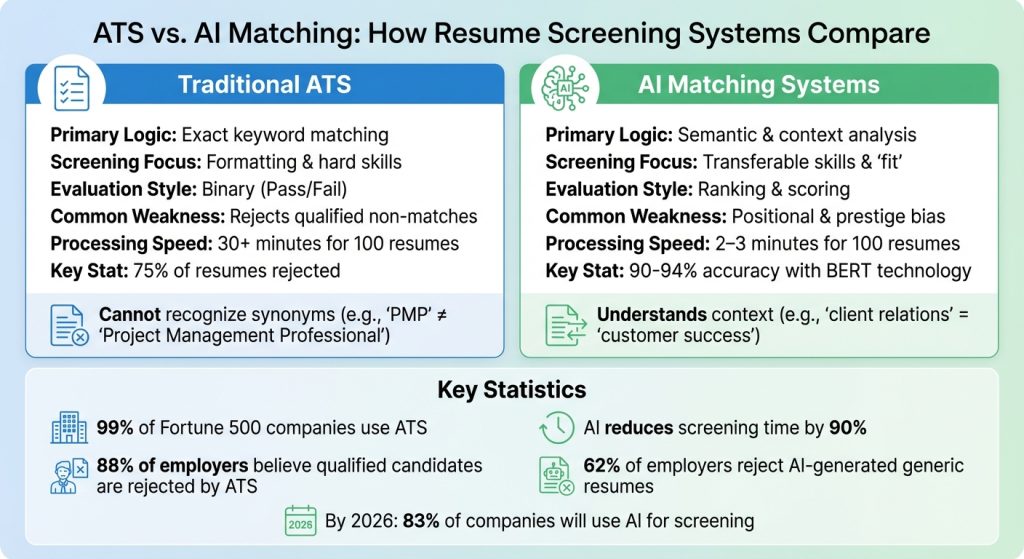
Once candidates are selected, AI may then run the rest of the screening process, from resume review to screening interview.
What about AI-generated resumes?
There are many problems with relying on AI to entirely write your resume.
It can be helpful for targeting and research, but you’ll need to do some of the writing yourself.
AI-generated resumes may make it through ATS fine, but they’re typically being weeded out by AI detectors because they’re generic, and lack context, skills analysis and personalization.
To meet the needs of the various kinds of people and technology reading your resume, you’ll need 3 different versions:
- An attractively formatted Word version (.docx) for humans
- A PDF version of the above so that the formatting will look the same no matter what device it’s called up on
- A plain, barely formatted ATS-friendly Word version (with little to no enhancements) that will make it through any of the several hundreds of different Applicant Tracking Systems software used to match candidates to jobs
It is possible for your formatted Word document resume to be compatible with some ATS software, but you’ll never know which system a company is using, so it’s safer to always prepare an ATS-friendly version.
Here’s what happens when you send your resume to recruiters and employers, and when you respond to job postings:
- Many recruiters and other hiring professionals will review every resume as they receive it and match you with a job they’re trying to fill, if you fit the bill.
- If you don’t match any openings, the document is put into a database or ATS, along with perhaps hundreds of other resumes, to call up later.
- Or, your resume may go directly into the ATS system.
- The ATS attempts to match candidates to particular job openings. The database sifts through the resumes and parses their content for the relevant keywords they’ve fed into it for that particular job. AI ATS goes further than this, as noted above.
- The only resumes selected are those that are formatted in a way that the ATS can “read”. And they have to contain enough of those relevant keywords.
- Resumes are not selected if they are incorrectly formatted, don’t contain enough of the right keywords, or don’t fit the bill in some other way.
The answer to the ATS conundrum?
Follow my suggestions in each of the 7 lessons I’ve outlined in this post, to craft an ATS-friendly resume that
- differentiates the unique value you offer your target employers
- is designed to resonate with those employers
- generates chemistry for you as a good-fit candidate by including a feel for your personality and how you operate.